Showing posts with label Chinese Idioms. Show all posts

Saturday, 27 September 2014

Black sheep....or horses?

      If you want to say that someone is the bad person in a family or in a group you can say he or she is the black sheep, right?

or you can call him or her "rotten apple"


   But how do you say all this in Chinese? 

   In Chinese, the idiom that indicates the bad element in a group does not present any sheep, instead, we find a horse, but it is not black at all. Let's see it:


In the first line you can find the characters, in the second line the pinyin (phonetic transcription), in the third the translation of the single characters in English, in the last line the translation of the single characters in Italian.


For those that are interested in the grammatical structure of the idiom, it is a name (horse) determined by a verb phrase. In English it would be "The horse that harms [its own] herd". In Italian it would be "Il cavallo che fa del male alla propria mandria". If you want to explain it in Chinese it is 危害马群的劣马.


    See you next time, if you have any comments please feel free to write it in the comment section!

Monday, 24 February 2014

Confucius says

jǐsuǒbúyù wùshīyúrén
This is a saying from the Analects of Confucius. If you want to know more about it, here's the sentence explained. The first column is the text in classical Chinese, the second column (the coloured one) is the translation of the single characters in modern Chinese, and the third is the translation in English.
"Do not do to others
 what you do not like done to yourself"

                                                    (Confucius, Analects)

Monday, 3 February 2014

Chinese Idioms Special 4: One horse takes the lead

  The year of the horse has just begun: Happy new year of the horse to everyone!
 
   And here it is: another Chinese Idioms Special:

yī mǎ dāng xiān
   This four-characters idiom  means "to gallop at the head", "take the lead", "be in the forefront", "to be the first to take the enemy or to do work". It is used to indicate that this time it's the turn of the year of the horse. 

   But, this idiom is part of a eight characters saying:

yī mǎ dāng xiān, wàn mǎ bēn téng

And here is the full idiom with pinyin and word by word translation:

   It means that, "when one single horse takes the lead in battle, ten thousand horses follow, going full-steam ahead".

   I hope you like this content, feel free tu make suggestions! ^_^
   See you next post!


Monday, 20 January 2014

Chinese Idioms 7: How often do you change your mind?

"Change one's mind constantly"
   This four-character idiom's structure is an apposition: the first part (sanxin) is parallel to the second (eryi). If your heart is three and

Wednesday, 15 January 2014

Chinese Idioms special 3: The year of the horse brings a lot of good luck!

This is the third special post dedicated to the soon beginning year of the horse. If you lost the previews ones, you can find them here and here.

mǎnián xíng dàyùn   jíqìngyǒuyú

Today's idiom can be translated as: "May the year of the

Tuesday, 7 January 2014

Chinese Idioms special 2: may the year of the horse bring riches!


 As promised in the previews post (see here), a new idiom regarding the year of the horse.
    Also this one is

Saturday, 4 January 2014

Felice anno nuovo del Cavallo!


(per la versione in inglese clicca qui)

   Come tutti sappiamo, il 2014 è cominciato; ma secondo il calendario tradizionale cinese, che è un calendario lunare, il nuovo anno comincerà tra circa un mese: il 31 gennaio 2014.

"Calendario lunare": il primo carattere (yue) significa "luna", il secondo (li) significa "calendario".

Il nuovo anno sarà l'anno del Cavallo: "ma"

Chinese Idioms Special: Happy new year of the horse


   As we all know, the year 2014 has begun. But according to the Chinese traditional lunar calendar the new year is going to begin within almost a month (on the 31st of January 2014).

   The new Chinese Year is going

Wednesday, 2 October 2013

Chinese idioms 6: golden chickens

Ever heard of a chicken standing on one leg? Chinese language does in fact have an idiomatic saying that describes this situation:

金鸡独立 jīn jī dú lì [listen]: standing on one leg like a golden rooster.

    This expression deriving from

Saturday, 7 September 2013

Chinese idioms 5: imaginary fears

Hi everyone! Back from summer break, I am going to present some four-characters Chinese idioms  (chengyu) that express in a metaphorical way the concept of imaginary fear.

  The first one is 杯弓蛇影 bēi gōng shé yǐng.

    This chengyu refers to the episode of the Han Dynasty (30 - 220 AD) where the shape of a bow hung on the wall, which is reflected in a cup, is mistaken for

Tuesday, 6 August 2013

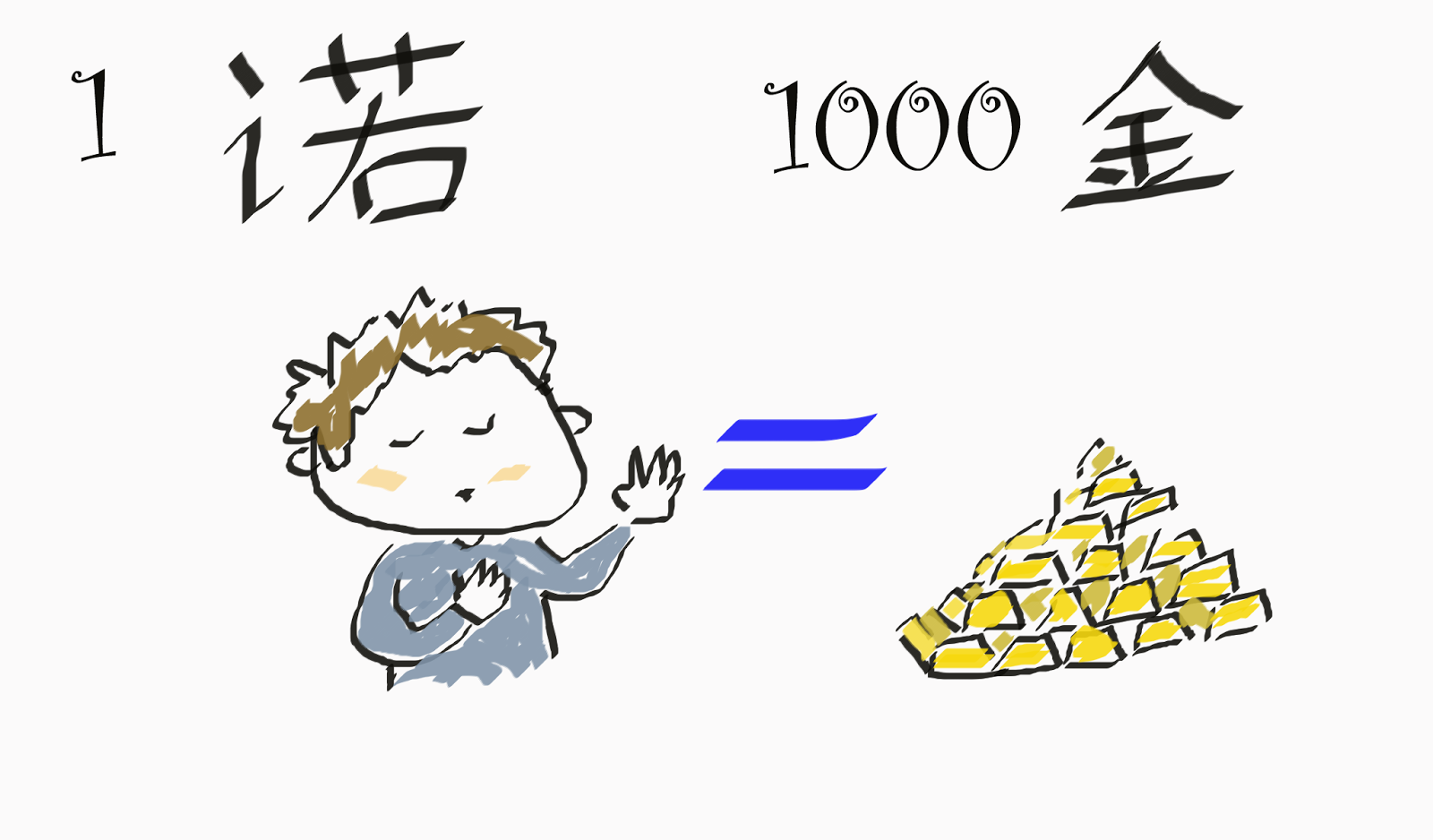
Chinese idioms 4 : 一诺千金


"A promise is worth a thousand ounces of gold", therefore "promise is debt". It is often used to describe a trustworthy person or behaviour. (ita: "Ogni promessa è debito")

   Looking at this four-character idiom more closely we could understand it as a a parallel between two units: "one promise" and "a thousand [pieces of] gold". It would be like "One promise [is] a thousand [pieces of] gold".


EXAMPLES:
  • 他一诺千金的作风赢得了大家的信任。
  • 她向来说话一诺千金


Monday, 1 July 2013

Chinese Idioms 3: 心狠手辣 xīn hěn shǒu là: Crudele e spietato

Guardando alcune serie tv cinesi ambientate nel periodo imperiale, ho imparato un'espressione di cui non si può fare a meno: 心狠手辣 xīn hěn shǒu là.
    Si tratta di un'espressione estremamente versatile: sia che il principe ereditario avveleni la concubina, che l'imperatrice reggente faccia pugnalare a morte il consigliere o che il ministro faccia arrestare ingiustamente e mettere a morte un testimone scomodo.

Wednesday, 26 June 2013

Chinese Idioms 2: 亡羊补牢 Wáng yáng bǔ láo: meglio tardi che mai

Questo chengyu (espressione idiomatica) parla di capre e recinti.
   Avete presente quel proverbio che dice "E' inutile chiudere il recinto quando la vacca è scappata"? (Forse è un modo di dire solo lombardo?). Bene, comunque, questo modo di dire cinese è esattamente il contrario! E non solo perché parla di capre invece che di vacche: 
   Ipotizzando che tu abbia una capra, 

Thursday, 13 June 2013

Chinese Idioms 1: 刻舟求剑 Kè zhōu qiú jiàn: Ignorare il mutare delle circostanze

Oggi, il primo chengyu (espressione idiomatica)! E' una vicenda che parla di un uomo stupido, di una spada e di una barca.

Da questa vicenda, l'espressione 刻舟求剑 (incidere la barca per recuperare la spada):
   E ora qualche appunto per chi studia cinese:
IN QUALE OPERA SI TROVA: Lüshi Chunqiu (吕氏春秋)

TESTO ORIGINALE: 楚人有涉江者,其剑自舟中坠于水,遽刻其舟,曰: "是吾剑之所从坠。"  舟止,从其所刻者入水求之。舟已行矣,而剑不行,求剑苦此,不亦惑乎?

SIGNIFICATO: (lett.) fare un segno sulla barca per recuperare la spada; (fig.) fare qualcosa ignorando il mutare delle circostanze, essere stupidamente privo di immaginazione.

SINONIMI:  缘木求鱼  yuán mù qiú yú; 
               登木求鱼 dēng mù qiú yú;
               守株待兔 shǒu zhū dài tù; 
               墨守成规 mò shǒu chéng guī

CONTRARI: 因时制宜 Yīn shí zhì yí ; 
                随时制宜suí shí zhì yí

ESEMPI
  • 局长生气地对秘书说: "现在情况已经发生了变化,你却像是刻舟求剑的人一样,一点也不知道变通一下。" (Il principale irato si rivolge al segretario: "La situazione ora è cambiata, invece tu non sei per niente flessibile, come chi incide la barca per recuperare la spada) (funzione: determinante nominale)
  • 凡是刻舟求剑,不知变化的人,很快就会被淘汰掉。(Tutte le persone che non si sanno adattare ai cambiamenti , saranno messe da parte in fretta.) (funzione: determinante nominale)
Alla prossima!